Molecular solids are held together by interactions far weaker than the covalent bonds within each molecule, and the balance of forces that sets their structure is easy to tip. Our group works to understand the fundamental principles of this balance and to find ways to control it by design. We do this at three limits, one built into the molecule itself (geometric frustration) and two imposed from outside (high pressure and low temperature). Each one reaches beyond ordinary conditions, giving access to new forms of order, new reactivity, new solid phases, and the emergent properties that come with them.
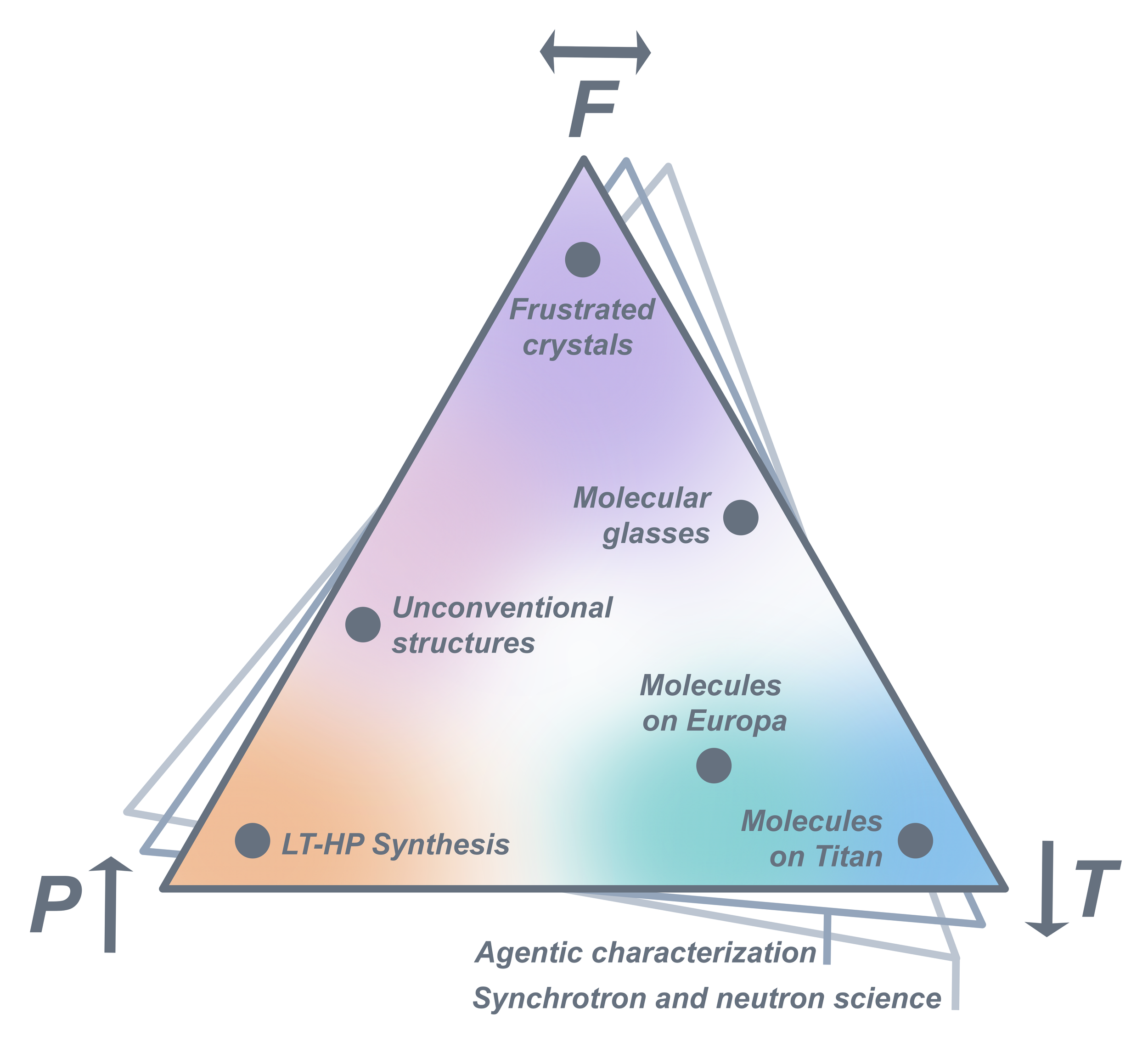
When molecules cannot fill space with their preferred local arrangement, the solid relieves the frustration, and in doing so it gives rise to unique emergent properties. We aim to tune phenomenon along a spectrum, from ordinary crystals to frustrated periodic packings to molecular quasicrystals, or from molecular crystals to glasses. Many of our building blocks are drug molecules, and the frustrated solids have applications in health. See our recent paper in PNAS 2026.
Under pressure, molecules are forced into contacts they avoid at ambient conditions, and crystal packing can then direct topochemical reactions that build extended solids with unprecedented structures. We design lattices that make room for reactivity, with the aim of lowering the pressures these reactions require, and we are especially interested in the regime where high pressure and low temperature act together. See our recent paper in Chem. Sci. 2026.
Our interest extends well beyond Earth, to icy moons whose surfaces are built largely from water ice, salts, and organic molecules. We recreate the conditions of Titan and Europa in the laboratory to determine which solids form there, how they are structured, and how they shape planetary surfaces, questions made timely by the Europa Clipper and Dragonfly missions. See our recent paper in JPCA 2026.
All of these directions produce structures that are hard to study. We address this with synchrotron and neutron measurements under the same extreme conditions, and we have pioneered AI-enabled characterization through agentic crystallography. See our recent paper in Nature Comm. 2026.